"We enjoy the joys of heaven"
The content on this page was translated automatically.
Windfuhr's workshop concerts with the Hamburg Symphony Orchestra
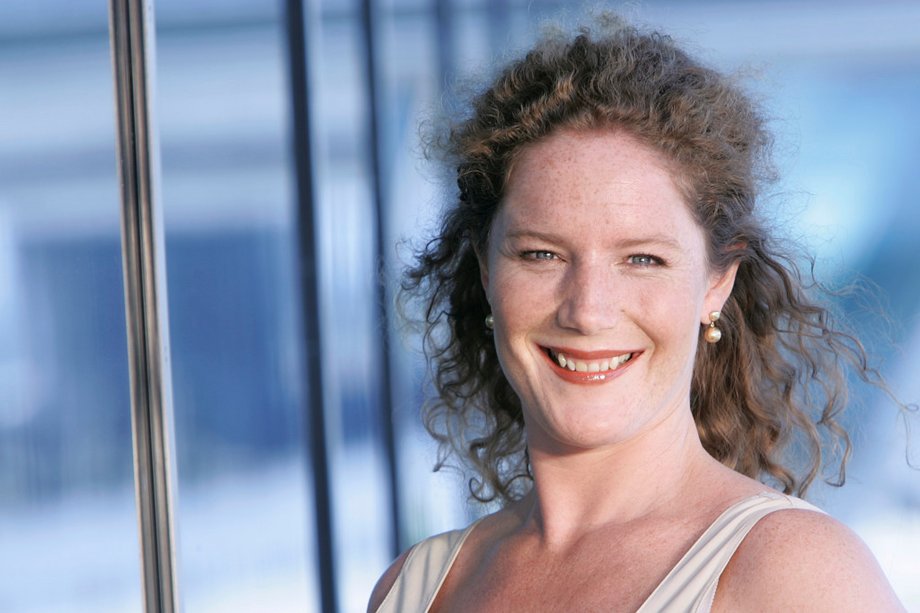
The program features the world premiere of Matti Pakkanen’s work “Umbra” as well as Gustav Mahler’s wonderful Symphony No. 4. The Hamburg Symphony Orchestra will perform under the direction of Ulrich Windfuhr. Soprano Michaela Kaune will make her debut as a new professor at the HfMT.
Date and location: Friday, July 13, 2018, at the HfMT Forum.
The concert begins at 7:30 p.m.; an introduction to the works will take place at 6:45 p.m.
Admission: 10 euros (reduced rate: 5 euros)
About the works:
Pakkanen: Umbra
The central idea of “Umbra” is the transition from simplicity to complexity, from clarity to obscurity. The piece begins with very soft flageolet tones in the strings. At first, only the overtones of D are heard. Gradually—opening out in both directions from the circle of fifths centered on D—more and more overtone series are added until they encompass the entire circle, like rays radiating in every direction. The superimposition of an ever-increasing number of overtone series causes a gradual shading of the texture until it becomes completely opaque; hence the name “Umbra” (sunspot). The second half of the piece consists of a 46-part micropolyphonic canon constructed using serial techniques, which slowly thins out until, in the end, only one overtone series on D remains. To achieve the greatest possible subtlety of texture and the densest possible micropolyphony, all strings are treated as soloists.
Matti Pakkanen was born in 1977 in Pori, Finland. He received his first piano lessons at the age of six and, a year later, enrolled in the music school at the Palmgren Conservatory, majoring in cello. He studied voice in Lahti, Finland, from 1998 to 2001, and in Järna, Sweden, from 2001 to 2003. From 2003 to 2007, he studied voice pedagogy and choral conducting at the Hamburg Music Seminar. There, he also took courses in microtonal music with Heiner Ruland. Since 2011, he has been studying composition at the Hamburg University of Music and Drama with Prof. Manfred Stahnke. Microtonality is usually prominently present in his music, and, in collaboration with the company “Marimba” in Bielefeld, he has also developed various percussion instruments with tunings that deviate from the standard. His own research in the field of microtonality was published in an article he wrote for the book “1001 Microtones” (Von Bockel
Verlag). From 2014 to 2017, he was a fellow of the Oscar and Vera Ritter Foundation. In the summer of 2014, he was “Composer in Residence” at the M.K. Sarbievius Cultural Center in Kražiai, Lithuania. His music has been performed in many concert halls around the world, such as Sage Gateshead in the United Kingdom and the Shanghai Symphony Hall.
Mahler: Symphony No. 4
Gustav Mahler composed his Symphony No. 4 during the summers of 1899 and 1900. Mahler completed the fair copy on January 5, 1901. The compositional process involved only three movements, as the finale had already been determined. For the finale, Mahler used the song “Das himmlische Leben” from his setting of the songs in *Des Knaben Wunderhorn*. The song had already been composed in 1892, while he was working on Symphony No. 2. Mahler originally planned to conceive his Symphony No. 4 as a symphonic humoresque. In this work, vocal elements were to be integrated much more extensively than was ultimately the case. Three of the planned six movements were to consist of songs from *Des Knaben Wunderhorn*, as evidenced by the earliest movement outline from 1896. However, the actual composition shares only the key of G major and the final movement with this plan.
The symphony’s premiere took place on November 25, 1901, in Munich with the Kaim Orchestra and soprano Margarete Michalik, conducted by Gustav Mahler. The work was a failure and left the audience bewildered. The style—less grandiose and pompous than that of the two previous *Wunderhorn* symphonies—disappointed the audience. The departure from Romantic pathos also caused confusion. The music critic Theodor Kroyer, for example, accused Mahler of writing a symphony that contained “no original feeling.” He claimed it was all “technique, calculation, and inner insincerity—a sickly, off-putting excess of music.” The *Allgemeine musikalische Zeitung* spoke of a “less than refreshing impression.” Only a few critics recognized the progressive value of the new work. Mahler’s friend Ernst Otto Nodnagel praised the premiere as “the first true musical event of the 20th century.” Theodor W. Adorno later remarked: “A masterpiece like the Fourth Symphony is a pretense from the first note to the last.” Today, Mahler’s Fourth Symphony ranks among the composer’s most popular works. Mahler himself described the symphony as one of his best works.
About the Performers
Michaela Kaune studied at the Hamburg University of Music and is, among other honors, a prize winner of the Belvedere Competition in Vienna and the German National Vocal Competition.
The artist has been a guest at major international opera houses for many years. At the end of the 2015–2016 season, she performed a complete run of *Der Rosenkavalier* at the Opéra de Paris under Philippe Jordan to great acclaim, in which she appeared as the Marschallin in one of her most important roles.
Michaela Kaune has close ties to the Deutsche Oper Berlin and was named a Berliner Kammersängerin in 2011. Also particularly noteworthy are her regular collaborations with the Bavarian State Opera in Munich and the Semperoper in Dresden, as well as guest engagements at the Opéra National de Paris, the Vienna State Opera, the New National Theatre, Tokyo, the Nederlandse Opera, La Monnaie in Brussels, the Grand Théâtre de Genève, and the Vlaamse Opera in Antwerp, as well as at the Salzburg Festival, the Bayreuth Festival, the Ravinia Festival, the Budapest Festival, the Maggio Musicale, Florence, the Festival de Radio France, the Musikfest Berlin, Carnegie Hall in New York, and the NHK Symphony Orchestra in Tokyo. In 2011, the artist was named a Berliner Kammersängerin.
In the 2013–14 winter semester, Ulrich Windfuhr assumed the professorship of conducting at the University of Music and Drama in Hamburg. In addition to training young conductors, a key focus of his work is conducting the university orchestra. Ulrich Windfuhr was born in Heidelberg in 1960. From 1978 to 1984, he studied piano, conducting, and chamber music in Cologne. He subsequently continued his studies with Franco Ferrara in Siena, Florence, and Rome. As a DAAD fellow in Vienna, he studied with Otmar Suitner and Karl Österreicher, and attended conducting courses with Gennadi Roshdestvensky, Carlo Maria Giulini, and Leonard Bernstein. In 1985, Ulrich Windfuhr was a prize winner at the Vittorio Gui International Conducting Competition and, in 1986, at the Janos Ferencsic International Conducting Competition in Budapest. After holding positions as principal conductor in Dortmund, Augsburg, and Nuremberg under Christian Thielemann, and in Hanover, he served first as acting general music director in Karlsruhe, then as general music director in Kiel. From 2006 to 2012, he was a permanent guest conductor at the Deutsche Oper Berlin. Since 2007, he has been a professor of conducting at the Leipzig University of Music and Theater (HMT). He serves as a juror for the German Conducting Competition and as a juror and course instructor for the German Conductors’ Forum.