"Room for spinning"
The content on this page was translated automatically.
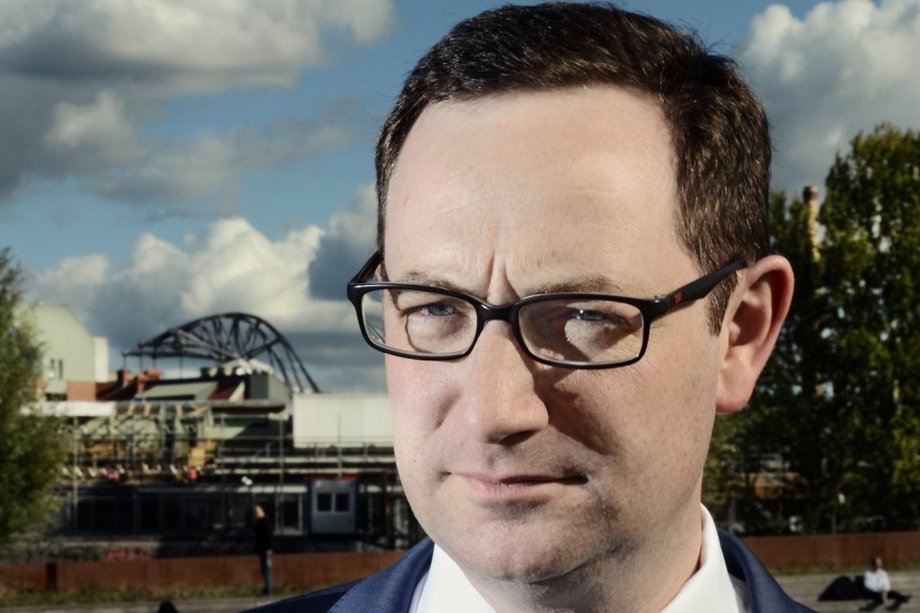
Gordon Kampe describes his first experiences as Professor of Composition at the HfMT. On May 13, the lateral thinker introduces himself with an inaugural concert at the Forum.
I’m still the “new guy” who’s glad to find the rooms of this labyrinthine Hamburg college largely intact. Everything that exists so far in the fields of composition, music theory, and related subjects—I didn’t invent it, of course, and it’s a joy, on the one hand, to find my place within the structure and, on the other, to discover where I can contribute something “new and different”—as my own teacher, Hespos, always likes to put it—with my background and experience. In fact, I’d love to learn a thing or two from him—after all, he once taught me for hours on end high up in a Ferris wheel or while strolling along the beach in all kinds of weather. When no Ferris wheel is available, however, it must always be mentally present as a source of inspiration for my major-subject classes in Room “107blue”—because that’s what it’s all about: movement, perspective, and expansiveness.
And to stick with this perhaps somewhat off-kilter metaphor: I don’t own a Ferris wheel; I just sit in the gondola for a while, and then together we look down, up, to the left, to the right, and everywhere else. And then we quickly get out of the gondola. Occasionally, Hespos would grab a musician—someone who was careless enough to walk past our seminar room: “Show us how to play the trumpet!” he’d say, and suddenly we’d have a mini-concert in the university stairwell. I suspect I’ll be a little less likely to take people by surprise—but I hope we’ll look for opportunities together where you wouldn’t expect them.
Apparently, or so I’ve heard, the weather in Hamburg can be a bit gray at times. The students I have the privilege of teaching in my major, however, are the exact opposite: The gender ratio is currently exactly 50 percent, and three continents are represented. More interesting than such statistics, though, is the vast range of interests. From performances featuring unicorns found by chance along the way, to the most delicate monophonic pieces, liturgical music, and all the way to orchestral works and events for which there is not yet a genre name—everything is represented.
On a practical note: A major advantage of an undergraduate program in Hamburg is the opportunity to remain undecided during the first few semesters: Whether you lean more toward music theory or composition—the two are by no means mutually exclusive. Even—and especially—in the third phase of your studies, the focus is once again on moving back and forth between disciplines and areas of interest: The “Dr. scientiae musicae” degree enables artistic research and scholarly reflection. Another very practical part of everyday student life is our colloquium, where we—in addition to composers and musicians — also invite people from the music world who don’t primarily discuss details about the poor response of the 17th overtone on a scordated baryton, which is undoubtedly important as well. Reports on opera dramaturgy or on the challenges and opportunities of the independent theater scene, as well as information on contemporary publishing and how GEMA operates, are just as much a part of the reality of life for aspiring composers. However, I have something entirely impractical planned for the winter semester: A seminar on utopia will attempt—initially on a trial basis—to abolish gravity. Sometimes I get the impression that “New Music” is already understood during one’s studies as a style that demands certain characteristics (such as duration, etc.). When I notice an increase in gravity, I like to tell people about my favorite dream. I dream of an opera house—one that can be installed on flat roofs or integrated into vacant buildings. It consists exclusively of mobile boxes that float freely in space. Moreover, so much energy is generated that everything around it glitters and sparkles. College must be the space for such flights of fancy, because here, not everything has to succeed yet—but it can.
Sunday, May 13
HfMT Forum
“Getting Started”
In his inaugural concert, Prof. Gordon Kampe presents a program he has curated, featuring lectures and music.
Performers include the “Ensemble S201” and Hui-Ping Lan (piano).
Starts at 8:00 p.m.; admission is free