"Unique training and event location"
The content on this page was translated automatically.
The new cultural heart of Barmbek is taking shape: On November 27, the topping-out ceremony for the future theater center was celebrated at Wiesendamm 26
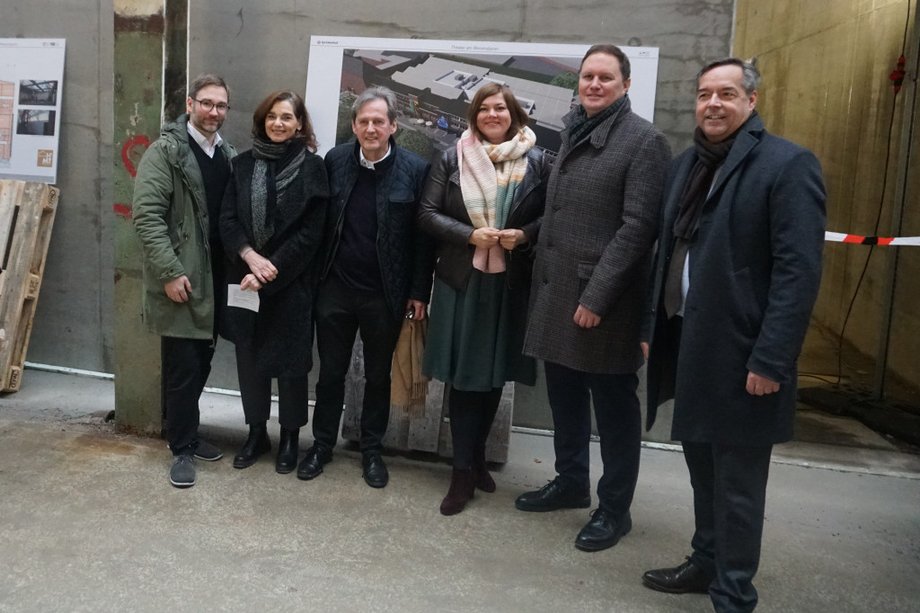
Things are moving forward! A new theater complex is currently under construction on Wiesendamm, which will eventually house the Junges SchauSpielHaus, the Theater Academy, and the Institute for Culture and Media Management of the University of Music and Drama (HfMT). On behalf of the City of Hamburg, Sprinkenhof GmbH is constructing new spaces for performances, rehearsals, teaching, and research in the halls of the former Heidenreich & Harbeck machine tool factory, covering an area of approximately 9,000 square meters. The structural work for the first renovations has now been completed.
In September 2018, the Senate set the course for Barmbek’s new cultural hub. Today, Katharina Fegebank, Senator for Science, Research, and Equality; Dr. Carsten Brosda, Senator for Culture and Media; Martin Görge, Managing Director of Sprinkenhof GmbH; Klaus Schumacher, Director of the Junges SchauSpielHaus; and Prof. Elmar Lampson, President of the HfMT, celebrated the building’s topping-out ceremony together with the construction companies. Starting in the fall of 2020, the future tenants are expected to be able to begin installing their own fixtures and gradually bring the space to life. The project costs total approximately 36.4 million euros. Together with the new premises of the Freies Theaterzentrum Wiese eG, located in the immediate vicinity, a new cultural center is thus emerging in the heart of Barmbek.
Katharina Fegebank, Senator for Science, Research, and Equality: “The Theaterzentrum Wiesendamm is creating a unique and highly attractive cultural and academic hub that will enhance the excellent training of future artists. The proximity of the Theater Academy, the Institute for Culture and Media Management, and the Junges SchauSpielHaus offers everyone involved excellent opportunities for collaborative projects—and strengthens cultural life in Barmbek. The interplay of training, academic study, and performance also fosters artistic exchange and enhances Hamburg’s reputation as a cultural and scientific metropolis. Students and theater enthusiasts alike will benefit from this.”
Dr. Carsten Brosda, Senator for Culture and Media: “A completely new and diverse cultural center is taking shape in the former machine tool factory on Wiesendamm. Together with other cultural institutions in Barmbek, it will shape not only the neighborhood but the entire cultural city of Hamburg. This successful development was only possible because many stakeholders at various levels worked creatively together toward a common goal. This collaboration can generate entirely new and inspiring momentum for the city. In the future, culture and science will find excellent working conditions on Wiesendamm and, above all, long-term prospects for development.”
Jan Zunke, Managing Director of Sprinkenhof GmbH: “As the developer and owner of the property, we are pleased to be working with the Junges SchauSpielHaus and the Theaterakademie to give the former iron foundry building and the surrounding neighborhood a new and, above all, sustainable use, thereby contributing to the cultural development of the neighborhood.”
Klaus Schumacher, Director of the Junges SchauSpielHaus: “We can hardly wait to move into the new theater on Wiesendamm. After a period of temporary solutions, the Junges SchauSpielHaus will move into a wonderful venue that not only meets current needs but also offers new possibilities for theater aimed at young audiences. Barmbek is a great location with many families and schools. The immediate surroundings will be very inspiring, and we hope that this new hub for young theater arts will attract many Hamburg residents.”
Prof. Elmar Lampson, President of the University of Music and Drama: “Ever since the Theater Academy was founded in 2005, our goal has been to bring all theater-related degree programs together under one roof. The fact that our Institute for Culture and Media Management will also be moving into the building is of outstanding importance for education, given the resulting opportunities for intensive collaboration and interesting synergies. The Theaterzentrum am Wiesendamm will become a unique educational and event venue with significant public appeal. I would like to thank the Senate of the Free and Hanseatic City of Hamburg and the Thörl Foundation for finally making this goal a reality.”
With the relocation of the Theater Academy and the Junges SchauSpielHaus from their former shared location on Gaußstraße to Wiesendamm in Barmbek, a new hub for young performing arts will emerge. The institutions will gain long-term stability, and the shared location will continue to foster creative exchange. In addition, the Institute for Culture and Media Management (KMM) will also be based on Wiesendamm in the future, creating valuable synergies for students, such as joint courses.
The theater center is located in the immediate vicinity of the equally new Freies Theaterzentrum Wiese eG, which offers additional performance and rehearsal spaces, as well as Kampnagel, the Zinnschmelze, the Museum der Arbeit, and the Hamburg Puppet Theater. This wealth of cultural institutions enables a whole new level of cultural exchange across different disciplines.
The Junge SchauSpielHaus Hamburg
The Junge SchauSpielHaus Hamburg is one of the most renowned children’s and youth theaters in the German-speaking world. Founded in 2005 as an independent division of the Deutsches SchauSpielHaus, its productions reach a large audience and have won numerous awards. Its current venue is the Große Probebühne at the Deutsches SchauSpielHaus.
At the new venue on Wiesendamm, the Junge SchauSpielHaus will have a total of approximately 3,500 square meters of space—including a good 3,000 square meters on the ground floor—for two stages and two rehearsal spaces, as well as workshops, offices, storage areas, and the necessary staff facilities. According to current plans, the stages will seat approximately 170 and 70 people, respectively. The technical equipment will enable the optimal use of artistic elements such as set design, lighting, sound, and video. All spaces accessible to the audience will be barrier-free.
The new location will thus create the conditions for the further development and expansion of the artistic and theater education programs. In the future, large-scale participatory projects can be carried out, and there will also be space for additional theater education or inclusive projects and open formats such as youth theater clubs.
The Hamburg Theater Academy at the University of Music and Drama
The Theater Academy at the HfMT was founded more than ten years ago and is one of the most renowned training institutions for directing, acting, opera singing, and dramaturgy in Germany. At the new location on Wiesendamm, nearly 5,800 square meters of space will be dedicated to transdisciplinary, self-organized, and research-based learning.
The directing programs will have two stages and five rehearsal stages—the necessary spaces to rehearse for course projects and final productions and to present their first productions to an audience. The acting department will also have its own studios on an old mezzanine level of the hall. For the master’s program in opera, rooms with appropriate acoustic equipment are being constructed. The stages and rehearsal spaces will be equipped with new stage, lighting, sound, and video technology, enabling artistic exploration and work with various media.
The Institute for Culture and Media Management at the University of Music and Drama
The KMM was founded in 1987 as the Institute for Cultural Management and is thus the oldest institution of its kind in Germany. Today, the Institute for Culture and Media Management offers an undergraduate Bachelor’s degree and a continuing education Master’s degree through distance learning, with courses taking place in over 20 German cities. In the heart of Hamburg, students can also earn a master’s degree through on-campus study in four semesters. With over 500 distance-learning students and approximately 45 on-campus students, the KMM is today not only the most established but also the largest provider of cultural management degree programs in Germany. In its teaching and research, the institute addresses all aspects of cultural management, such as project management, marketing, and financing, among others. A particular focus is placed on the areas of leadership, innovation, and digital transformation. Its proximity to the Theater Academy creates previously unimagined opportunities for collaboration between artistic and cultural management practices right under one roof.