Peter Ruzicka in a double pack
The content on this page was translated automatically.
World premiere of the opera Benjamin at the Staatsoper, orchestral work Elegie at the Forum
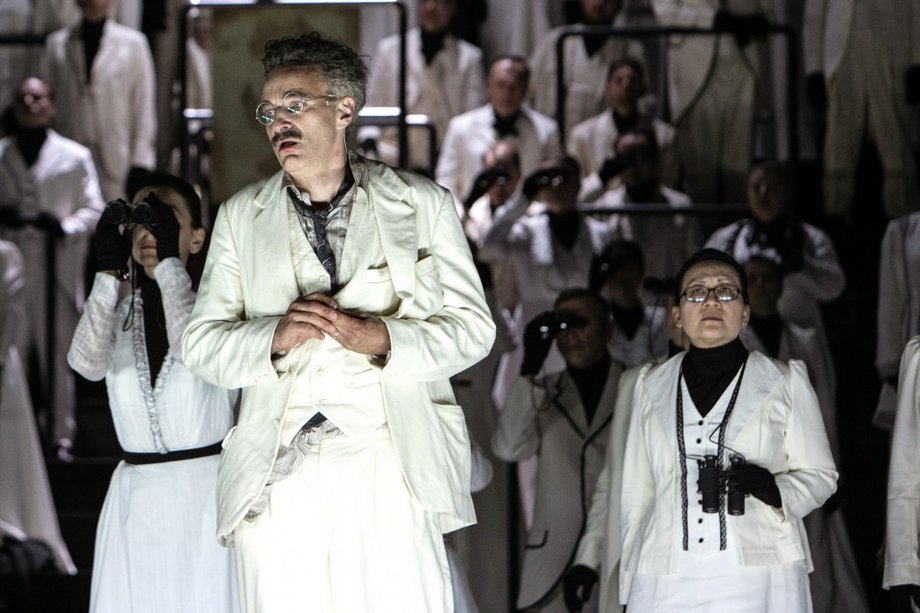
He is a professor at the Institute for Culture and Media Management, holds an honorary doctorate from the university, serves as artistic director of the Salzburg Easter Festival—and is a composer in high demand worldwide. Now, Peter Ruzicka’s latest opera, *Benjamin*, commissioned by the Hamburg State Opera, can be seen at the Dammtorstraße venue. The composer himself will conduct the Hamburg State Philharmonic Orchestra; Yona Kim, a lecturer in directing at the HfMT, will direct the production, with Angela Beuerle, a faculty member at the Theater Academy, serving as dramaturg. To accompany the world premiere, the university’s symphony orchestra will perform Peter Ruzicka’s orchestral work *Elegie* on June 11 in the HfMT Forum. Ulrich Windfuhr will conduct.
Walter Benjamin was a German philosopher and cultural scholar. His life journey as a Jew and Marxist through the 20th century was erratic and bewildering. The characters who accompany Benjamin on his final journey in this opera delineate the scope of his influence. Hannah Arendt spoke of the “banality of evil,” Benjamin’s chess partner Bertolt Brecht polemicized against his “Jewish fascism”; the Kabbalah scholar Gershom Scholem wanted to bring his friend to Israel; and with the Latvian actress Asja Lacis, Benjamin fantasized about proletarian children’s theater. It was not the world revolution, but the “weak messianic force” that showed Benjamin the way to a just society. While fleeing to the United States, Benjamin took his own life in 1940 in the Spanish border town of Portbou.
And an opera about this Walter Benjamin? “A life can only be shared in the present, only directly; the rest is speculation and construction, born of our greed for ‘stories,’” said librettist and director Yona Kim about her reflections, which appeared at the beginning of the libretto for this
opera. “For,” Yona Kim continues, “it is by no means a matter of retelling Walter Benjamin’s biography; rather, it is an attempt at musical theater that seeks, in its dramaturgy, to capture the magical rhythm of his radically boundary-crossing thought—a thought that seeks no closed system of ideas, no home, but is restless travel itself.”
While the internal structure of this opera libretto is anchored in the movements of Benjamin’s thought, its external framework is provided by references to specific people and events that were decisive in Benjamin’s life. Alongside Walter Benjamin—here Walter B.—appear Dora K. (Kellner), Gershom S. (Sholem), Bertolt B. (Brecht), Asja L. (Lacis), and Hannah A. (Arendt). Like the title character himself, they oscillate between the memory of their real-life counterparts and their reality as opera characters with specific functions and attributes in relation to the plot. A clearly defined narrative situation—the end of Benjamin’s life—forms the core of the opera: “The starting point for the libretto,” Yona Kim explains, “was a scenic idea that was at once a scenic question: What is going through Walter Benjamin’s mind as he spends that September night alone in a clearing in the Pyrenees while fleeing the Nazis?”
The music that Peter Ruzicka composed for this text draws on this narrative framework and develops it further through musical means: “The opera *Benjamin* was preceded by a purely orchestral work titled *Flucht* (*Flight*). In it, I attempted to describe the specific ‘tone’ that would define the later opera score. Benjamin’s restless travels have themselves become sound here. One may sense in the score something of the discontinuity of his thought and also come to know the Walter Benjamin plagued by depression and loneliness. The musical gesture appears throughout as a ‘journey inward,’” says Peter Ruzicka. The restlessness of the musical gesture and the diversity of the images conveyed through sound are framed by a clear structure of musical-theatrical narrative: A prelude introduces the work and foreshadows, through sound and motifs, what is to come, which will unfold in the following seven “stations” along with four orchestral interludes. Through its gestural and atmospheric power—which draws this music from a spectrum ranging from silence to the greatest expressiveness, from the highest, percussive-rhythmic movement to stillness, and from the most exaggerated, acrobatic art song to speech—a sonic unfolding that reveals the epochal dimensions of these characters’ lives and thoughts.
Peter Ruzicka
Benjamin – World Premiere
Sunday, June 3, 2018, 6:00 p.m.; additional performances on June 6, 10, 13, and 16, all at 7:30 p.m.
Hamburg State Opera
Conductor: Peter Ruzicka
Director: Yona Kim
Set Design: Heike Scheele
Costume Design: Falk Bauer
Lighting Design: Reinhard Traub
Dramaturgy: Angela Beuerle
Peter Ruzicka
Elegy – in a concert performance with the orchestra
HfMT Symphony Orchestra
MONDAY, June 11, 2018, 7:30 p.m.
HFMT, FORUM
Peter Ruzicka: Elegy
Franz Liszt: Piano Concerto No. 2 in A Major
Antonín Dvořák: Symphony No. 7 in D minor, Op. 70
Soloist: Eun-A Kim, concert exam (class of Prof. Anna Vinnitskaya)
Conductor: Ulrich Windfuhr