Innovation you can touch: ligeti center celebrates successful open day
The content on this page was translated automatically.
The entire ligeti zentrum opened its doors for the first time on November 22, 2025. Under the motto “Hands-On Innovation,” the interdisciplinary labs and projects offered a wide range of opportunities to try things out and get involved—with great success. A look back.
From remote-controlled robots to interactive installations, from healing soundscapes to palliative dramaturgy, from 3D audio to virtual reality: The open house impressively demonstrated just how broad the ligeti zentrum’s scope is in Hamburg-Harburg. For the first time since its opening in May 2023, the interdisciplinary transfer center invited interested visitors and collaboration partners to take a comprehensive look at all its labs and projects.
After a day that was well-attended from start to finish, the team looks back on numerous stimulating conversations and exciting encounters. “The ligeti zentrum’s first Open House was a great success,” summarize the project leaders Prof. Dr. Georg Hajdu (HfMT Hamburg), Prof. Dr. Robert Mores (HAW Hamburg), Prof. Dr.-Ing. Thorsten Kern (TUHH), and Univ.-Prof. Dr. Sebastian Debus (UKE). “Throughout the day, we were joined by an interested and, above all, diverse audience from the Harburg neighborhood as well as from across the city of Hamburg. We were particularly pleased that many guests were visiting the ligeti zentrum for the first time and spent several hours at our interactive stations. This not only shows that we were able to offer an engaging, full-day program; it also makes it clear that the ligeti zentrum meets a genuine need for interdisciplinary formats that have not previously existed in Hamburg in this form.”
“The open house makes it clear that the ligeti zentrum meets a genuine need for interdisciplinary formats, the likes of which have not existed in Hamburg in this form until now.”
Arts and Science in Dialogue
How do the arts and science intersect—and what can they learn from each other? At the start of the day, Christian Carstensen (Head of the Harburg District Office), Prof. Dr. Georg Hajdu (Director of the ligeti zentrum), Prof. Dr. Sabine Maasen (University of Hamburg), Prof. Dr. Jan Philipp Sprick (President of the HfMT Hamburg), and Margo Zālīte (theater director and sound artist; Sustainable Theater Lab). Moderated by freelance journalist Ulrike Henningsen, they discussed Hamburg as a hub for science, its potential, and the role of the ligeti zentrum as an interdisciplinary interface—both between universities and between science and society.
Interactive Stations on Two Floors
After the panel discussion, all stations on both floors opened around noon. In the large flex office on the 9th floor, guests could try out the interactive Dance Booth—a music installation that changes its rhythm based on button presses and the movements of its users. Meanwhile, in the conference room, various digital synthesizers were set up, while the painting robot from the Haptic Lab translated the generated sounds into images.
Project lead Dr.-Ing. Ornella Tortorici Pabst reported having many exciting conversations at her station. She particularly remembers one visitor with synesthesia: “People with synesthesia perceive sensory impressions in a linked way—they hear colors, taste sounds, or see words in shades of color. In a way, the painting robot does something very similar: it translates sound into colors and patterns. The conversation offered fascinating insights and, at the same time, gave me new ideas for the further development of the painting robot.”
The Arts: Analog, Digital, Virtual
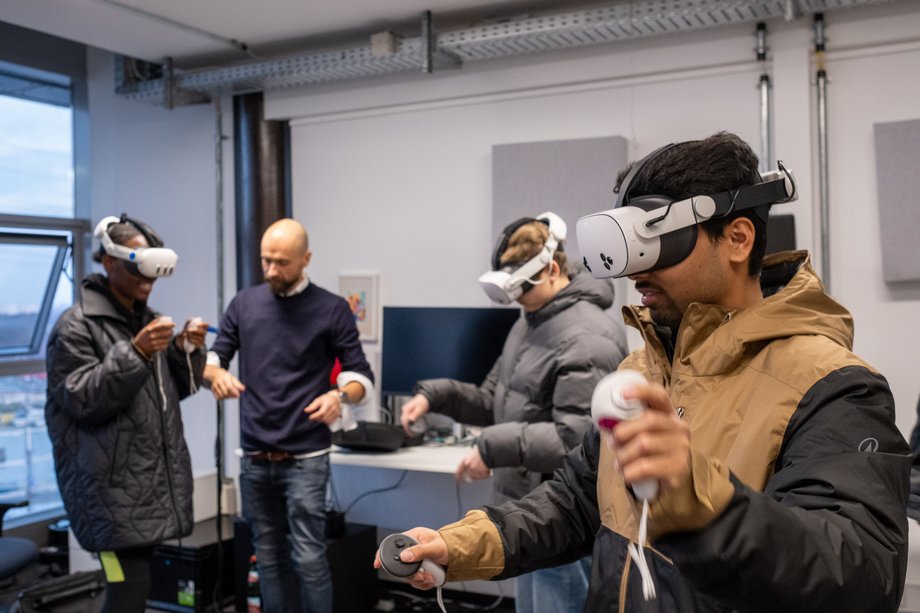
From walk-through VR artworks from the Moving Sound Pictures project to the Spatial Sampler—an instrument that reimagines the connection between sound and movement in mixed reality: Wearing VR headsets, visitors on the 10th floor were transported into immersive, artistic worlds.
“I’d say there were about ten people in the InnoLab at any given time on average,” says Dr. Greg Beller, who not only presented his project, the Spatial Sampler, as a demo but also gave visitors the opportunity to try out the XR instrument for themselves afterward. “I repeated the presentation about ten times throughout the day. The visitors seemed to be thrilled in the truest sense of the word—their eyes were wide with wonder!”
While the Production Lab transformed into a 3D audio listening room during the day—where musicians could also test their own sounds—the SPIIC+ Ensemble led the way to a convivial conclusion in the late afternoon with a musical performance.
“The response to the day was truly overwhelming,” says Nadine Schwalb, director of the Agency for Outreach and Social Participation. “We were delighted that so many guests attended and that we were able to inspire such a diverse audience. The mix of children, families, students, seniors, and people from the neighborhood made the open house a particularly enriching experience. We definitely want to repeat an event like this in the future.”
Knowledge Transfer Between Universities and Society
The ligeti zentrum will continue its interdisciplinary and innovative approach throughout the second half of the funding phase under the Innovative University initiative. On December 3, 2025, for example, robots, musicians, and staff members from the center will present the stage show “Lost in Translation.” The evening will not only offer practical insights into current projects but will also foster an artistic-scientific dialogue between music, robotics, and experiments, in which interpretation and shifts in meaning become a performance in their own right.