Sound paths of China
The content on this page was translated automatically.
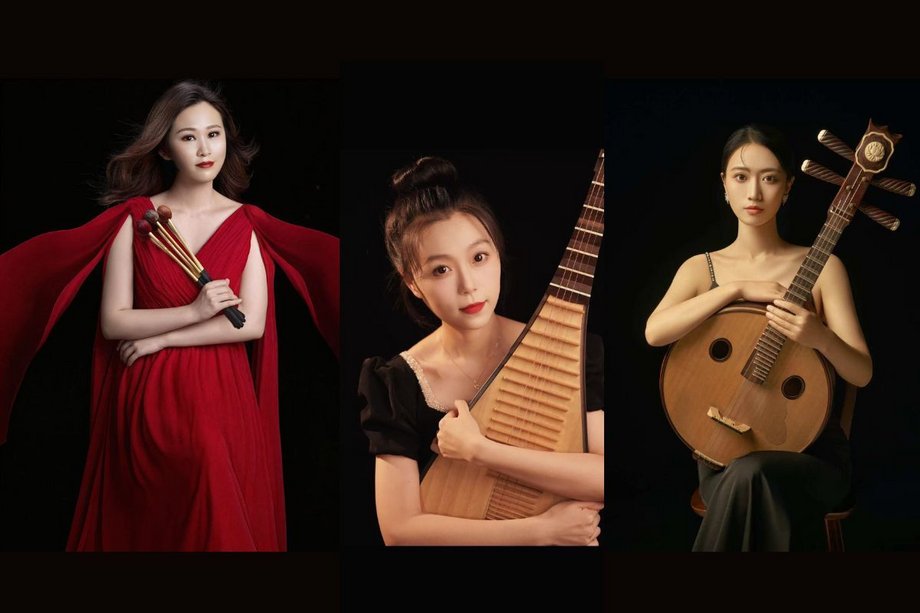
Chinese music has evolved over more than a thousand years from a rich tradition in which percussion and string instruments play central roles. The big drum (鼓 gǔ) is one of the oldest instruments in East Asia; its sound structured rituals, ceremonies, and military signals, thereby shaping the social life of entire eras. The pipa (琵琶) lute reached China via the early trade routes of Central Asia and became a leading melodic instrument during the Tang Dynasty, shaping both courtly and literary musical forms. The ruan (阮), with its round body and soft tone, is a uniquely Chinese instrument whose history can be traced back to the Han Dynasty. None of these instruments has a Western counterpart that is as old and is still played today.
Together, these instruments showcase the vast stylistic range of Chinese music: from distinctive rhythmic structures to narrative lute music and regionally influenced dance forms. Today’s program draws on these traditions and combines them with well-known works ranging from historical landscapes to folk festivals.
Program
Dragon Flight and Tiger Power (solo on the large Chinese drum)
Spring in the Tian Shan Mountains
Moonlit Night on the Spring River Full of Flowers
Give Me a Rose
Intoxication of Joy (ruan solo)
Camel Bells of the Silk Road
Dance of the Yi
Ambush from Ten Sides (Pipa Solo)
Tajik Dance
Night of the Torch Festival
Performers
KE Nan – pipa (琵琶)
LI Na – ruan (阮) CHEN Yifan – traditional percussion (民族打击乐)
About KE Nan
KE Nan is a lecturer and musician with a master’s degree who specializes in playing the pipa. She is the secretary of the Anhui Pipa Society of the China Musicians Association and deputy secretary-general of the Wang Yuting Pipa Research Center of the Anhui Provincial National Orchestra Association. She received her training from Professor Fan Wei and Professor Li Guanghua at the Central Conservatory of Music in Beijing. She has been teaching at the Anhui Vocational College of Art since 2013. As early as 2005, she made a guest appearance at the invitation of the Manchester School in the United Kingdom and, during her studies, participated in numerous national stage productions, including at the National Center for the Performing Arts in Beijing and at the opening ceremony of the 2008 Olympic Games. She is a prize winner of several national and international competitions—including the Dunhuang Cup, the Huayue Chamber Music Competition, and the International Competition for Traditional Musical Instruments—and has received multiple awards for outstanding teaching.
About LI Na
LI Na is a lecturer and holds a doctorate in music (Dr. phil.) with a focus on ruan performance. She is a member of the Communist Party of China, an examiner for the Chinese National Orchestra Society, a member of the Anhui Provincial Musicians’ Association, and
a board member of the Anhui Provincial National Orchestra Society. As a representative of the fifth generation of bearers of the provincial intangible cultural heritage “Liuqin Performance from Northern Anhui,” she is deeply committed to preserving and passing on traditional Chinese music. After completing her bachelor’s degree at Anhui Normal University, she earned her doctorate at Thonburi University in Bangkok. She has been teaching at Anhui University of the Arts since 2016. For her outstanding teaching, she received the first prize for teaching excellence; under her guidance, her students have repeatedly been honored at the national and provincial levels for their artistic practice and competition achievements.
About CHEN Yifan
CHEN Yifan is a young lecturer and musician with a master’s degree, specializing in percussion. He is a member of the Percussion Committee of the Chinese National Orchestras Association, a member of the Percussion Society of the Chinese Musicians’ Association, and a board member of the Chinese Marimba Society. He also founded the Percussion Ensemble at Anhui University of the Arts and serves as a percussion examiner on behalf of the Chinese Ministry of Culture and Tourism. He completed his master’s degree in percussion at the Central Conservatory of Music in Beijing; in 2020, he joined the Anhui University of the Arts as a rising talent. As lead author and editor, he published the first textbook on “Chinese National Percussion Instruments” in Anhui Province. Under his guidance, his students have repeatedly received major national and provincial awards.
Eintritt frei
Registration is required and can be done via eventbrite.