Room '200 blue'
The content on this page was translated automatically.
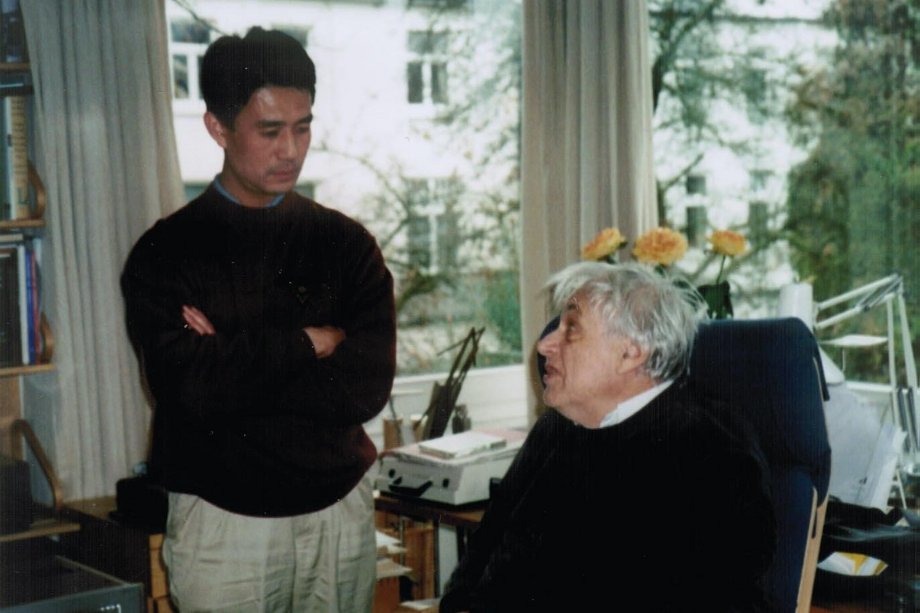
György Ligeti's classroom
György Ligeti was Professor of Composition at the Hamburg University of Music and Drama from 1973 until his retirement in 1989. His cosmopolitan attitude, his work as a teacher, his artistic diversity, his interdisciplinary thinking and not least his immense importance for the development of New Music continue to have an impact on the university to this day. To mark the 100th anniversary of his birth, the HfMT is planning a week of celebrations from May 2 to 7, 2023, which will include master classes and concerts as well as an academic symposium.
He taught in room 200 in the blue wing.
What were his lessons like? Let 3 of his former students have their say.
Manfred Stahnke
Manfred Stahnke talks about his lessons with György Ligeti.
An excerpt from the ORF production Grenzklänge - Das Phänomen György Ligeti from 2003.
Director: Herbert Eisenschenk
Xiaoyong Chen
A door ajar and a gateway to the world - memories of the 80s with György Ligeti
A journey into the unknown, but hopeful for the future?
I arrived in Hamburg in August 1985. The door to the apartment on the second floor in Mövenstraße greeted me ajar and with a voice: "Come in". I was a little nervous and suddenly saw the master in front of me. Is this all real or just a dream? I heard the name György Ligeti for the first time at the end of 1980.
China had just reopened to the world after 30 years of isolation. At that time, I was like a frog in a well and believed the world was as big as a shining full moon.
A little information about my first music contacts
As a teenager in the early 70s, I heard European classical music for the first time through a few 78 gram vinyl records that my father owned. After a while, I secretly listened to the tapes of Debussy, Bartók and Stravinsky. At that time, such music was still forbidden. In 1980 I began to study composition in Beijing and five years later with Ligeti in Hamburg. In 1986 I got to know the Darmstadt Summer Courses and a year later the Donaueschingen Music Days. I have been a composer ever since.
Studying with Ligeti
The lessons always began on Wednesdays at 3 p.m. and went on until late at night at his home. Everyone brought their own score so that everyone could read it. Ligeti usually asked for opinions before ending the discussion with his words. One day I was about to present my compositions. I had brought three pieces with me from my time in Beijing: a violin concerto, a piano quintet and several short piano solos.
When I left my hometown, I was looking forward to catching up. Catching up was supposed to mean learning and mastering all modern composition techniques. My expectations were not fulfilled that day. On the contrary, Ligeti was less enthusiastic about my violin concerto and said that although it was technically well done,
it was too much influenced by the Polish school. Unexpectedly, he paid more attention to the piano quintet.
I was hardly touched by the Western. Instead, I had ideas based on the Peking Opera or a speech melody that I could shape freely. Ligeti encouraged me to "continue on this path". Although I didn't really understand the exact meaning of this phrase at the time, I began to write a new piece with this idea in mind.
At the beginning of June 1986, I already had part of the score for the First String Quartet. I showed it to the class. Ligeti waited a while and said: "This music is strange to me. ... It has to be played", "Go to Arditti" ...
Visit to the Darmstadt Summer Courses and the Donaueschenger Musiktage
"Musical window opened", "Vital", as his teacher György Ligeti wrote in his report, ...", as it was written in the regional newspaper (Stadt Darmstadt July 1986).
Friedrich Hommel told me that without Ligeti's words he would never have been able to get me the scholarship for Darmstadt. When he received this letter, there was only a month to go before the courses started.
When I returned to Hamburg from the south in August, I found a letter in my letterbox from Josef Häusler from Baden-Baden. In it he asked about my music and the unfinished quartet. It wasn't until October 1987 that I realized the significance of the small town of Donaueschingen in the Black Forest.
A look back: a journey into the unknown, but hopeful for the future?
In July 1985, I completed my studies in Beijing and boarded the Trans-Siberian Railway on July 31. The train headed west. The journey took seven days, one change in Moscow, through Warsaw to East Berlin. I walked over the Berlin Wall to West Berlin with two suitcases and continued on to Hamburg the next day.
The journey, especially the stretch in the former USSR, was not at all smooth, in fact it was very dramatic. I was detained at the Russian-Polish border for more than two hours. To this day, I can't explain how I regained my freedom without losing anything. I must have been protected by God.
My experience became the story that Ligeti told again and again.
Entrance examination and then
1985 was a strong year in terms of numbers. Hans Peter Reutter from Germany, Sidney Corbett from the USA, Kiyoshi Furukawa from Japan, Unsuk Chin from South Korea and myself from China took part in the entrance examination. The day after the entrance exam, I went back to Ligeti. "You did well in the exam...", "Whether you get a place or not, you are already my student".
After listening to my plan, he said to me: "You have to learn German at a Goethe-Institut right away". He pulled two large banknotes out of his pocket. "How can I give you the money back?" I asked him cautiously. He smiled and answered me: "You can pay me back when you've become famous in twenty years' time"...
Beyond composing
Once he asked me to hang out with him for a while after the lesson and told me a lot about his sad past, the loss of his father and brother, the 60s and 70s and so on. That's when I realized that what he did and how he treated me meant a lot more than just the music or composing itself. Is it because of similar backgrounds, similar experiences and pain? Never give up and go forward with a fighting spirit.
Another look back: cultural and political context
At the end of 1972, before the end of the so-called "Cultural Revolution", a cellist from Switzerland performed a repertoire consisting mainly of Johann Sebastian Bach to an audience selected by the government in Beijing. He was invited by the Chinese government. The following year, the London Philharmonic Orchestra played music by Ludwig van Beethoven, Johannes Brahms and others in
Beijing. In the summer, the Vienna Philharmonic Orchestra performed with Claudio Abbado in China. These programs stood in stark contrast to the propaganda music that was played daily on radio stations. Jiang Qing - Mao Zedong's wife - directly directed the projects, whose motto was the
political slogan: "Serve the past for the present and let foreign things serve China". In practical terms, this opened a small window for me to come into contact with foreign cultures.
It was only with the death of Mao Zedong on September 9, 1976 that China experienced a major turning point. The violin virtuosos Isaac Stern and Yehudi Menuhin came to Beijing in 1979 and taught in Beijing. China entered a flourishing age ideologically. What had previously been forbidden was now legal again. Modern art, which had been called "bourgeois corrupt art" in the
past, was once again included in the crystallization of human civilization. A group of young people reacted enthusiastically and wanted to reclaim everything they had lost and quickly return to the world. It was this personal experience of mine that attracted Ligeti.
It's not easy to understand all this if you don't know China at that time. Cultural expressions are very open in many countries, but China at that time was a vacuum and the "destiny" of the people was not in their own hands. The so-called vacuum meant that no one was allowed to know about open culture. A bird locked in a cage can see the space around the cage, but it is absolutely impossible to reach that open space. A generation of colleagues older than me who tried to write modern music in the 50s and 60s found themselves in life-threatening situations.
Like a thirsty and hungry person, extreme overreactions can take many forms. Once really free, there seems to be a strange feeling of joy, passion, curiosity, but also insecurity, disorientation and even fear.
Cultural identity and artistic orientation
I grew up in a country far away from Europe, with specific cultural characteristics. This can be a "weak point" when I deal with European music. For a while I had the oppressive feeling that many people in other Asian countries like Japan, South Korea, even in some South Asian countries, knew much more than I did. It took me a while to overcome the "shortcomings" I had in my childhood and adolescence and this "shadow"! After many years, this has turned into positive energy. I thank my mentor Ligeti for that! To this day, I like to describe myself as a person who "accidentally" slipped into a group of composers and who caught the last train halfway.
At the time, I had no idea about the "composing profession", but I was determined. Ligeti did a lot for me. Not only that, he also set me on the path of a composer - as an irreplaceable and unmistakable person. As a challenge, according to Ligeti, originality should always be in the foreground for him.
The Ligeti class and the importance of composing
During those years, I was part of a close working team. There are some people in the group whom I sincerely thank because they helped me, such as Tamae, Kiyoshi, Manfred, etc. The one who took care of me the most was Louise Duchesneau, like my big sister. Composing is now a much bigger part of my life than it was 38 years ago. For me, it is the most important form of fixing and expressing inner thoughts and
feelings. Music is a reaction medium to my perception and world view. A serious and self-critical attitude is very important. It is equally important to be courageous instead of hesitating or waiting. To make all this possible, I would like to thank my teacher Ligeti, who showed me a way. He changed my life and helped me to concentrate on writing music for almost 20 years without any financial burden. Here I take the liberty of revealing a small part of the "secret":
"Dec. 1, 94
Dear Huihong,
dear Xiaoyong,
warmest congratulations for VERONIKA!
I think as a birth gift it is more practical if you choose what is necessary -
therefore please accept the enclosed sum - real and symbolic,
Your György Ligeti"
remembered by Prof. Xiaoyong Chen
Hamburg, January 12, 2023
Wolfgang-Andreas Schultz
Craft and Aesthetics – György Ligeti as a Teacher
I.
Beginning in 1975, when I joined György Ligeti’s composition class as a student (as an “extraordinary student,” as it was called in Hamburg at the time, since I had already completed my composition studies with a diploma), until his retirement in 1988, I worked with Ligeti, first as his student, then as his assistant. We always got along brilliantly when it came to the craft of composition, even though our views on aesthetic matters differed quite a bit. Perhaps this difference is not the worst starting point for reflecting on the relationship between craft and aesthetics through my memories of Ligeti as a teacher.
It must have been in 1976 that Ligeti and his class, as they often did, were spending their lunch break at “Café Bohème” near the conservatory when he said: “Actually, every one of you should take counterpoint lessons with me—in the strictest Bach style, just as I learned it in Budapest from Farkas—it’s very helpful for composing. But unfortunately, I don’t have time to do it with everyone—that’s why, when I was appointed, I made sure to secure permission to hire an assistant. This assistant will take over the counterpoint lessons for future students. Would any of you like to do that? It would mean a very rigorous two-year apprenticeship with me—there won’t be any time left for your own composing—and afterward, I’ll negotiate teaching hours with the conservatory.” To this day, I still don’t understand why I was the only one who volunteered. Well, I come from a family of church musicians and grew up with Bach’s music, so I felt confident I had a good sense of the style, and thanks to my first teacher, Ernst Gernot Klussmann, I’d already acquired a solid foundation in counterpoint—though not in the Bach style.
My time studying counterpoint with Ligeti was very intensive. Unlike the composition classes, which took place almost exclusively in a group setting, these were now one-on-one lessons. Ligeti had an incredibly keen ear for stylistic inconsistencies, whether it was a modulation into the dominant key that had gone on a bit too long or the appearance of a stylistically questionable sixth chord. By then, however, he himself had strayed too far from the practice of the Bach style to be able to suggest specific improvements—I had to figure those out on my own. After a three-part fugue with a chromatic theme, which could be mirrored in its entirety following the model of *The Art of Fugue*, after a five-part chorale prelude with a cantus firmus in canon and a three-part chorale arrangement with a cantus firmus in the bass and two upper voices in canon, he shook my hand and declared me a “master of counterpoint.” My apprenticeship lasted only a year and a quarter, and during that time I also composed my “Concerto for Viola da Gamba and Orchestra.”
In 1977, I was appointed to a teaching position at the Hamburg University of Music for music theory, including an assistantship in György Ligeti’s composition class. In addition to teaching counterpoint to all composers who would henceforth study with him (some came from abroad for a year, while others had already completed their studies), my responsibilities soon expanded to encompass the entire theoretical curriculum (harmony, Bach and Palestrina counterpoint, classical instrumentation, modulation, cadence exercises, etc.) for all those aiming to earn a diploma at the Hamburg University of Music.
To maintain contact with Ligeti and to follow the compositional development of my counterpoint students, I regularly—though at irregular intervals—attended class sessions, where I also presented my latest compositions. Occasionally, Ligeti would even ask me for help—for example, in the case of a student who submitted an incredibly complex orchestral work and stubbornly insisted that it was transparent. Ligeti strongly disagreed and eventually asked me to explain why the score was not transparent. I tried to make it clear to the student that one must group events into layers and compose around overarching processes and developments—Ligeti was apparently very satisfied with my explanation, and the performance must have proven both of us right.
As much as the impression arose that Ligeti demanded absolute professionalism in technical craftsmanship, his doubts about this ideal were just as unmistakable. He was equally fascinated by the idea—or should one say, the phantom?—of an untrained, original genius. For him, Mussorgsky was such an example, serving as a counterpoint to the at times somewhat academic professionalism of a Rimsky-Korsakov. He repeatedly flirted with the cultural landscape of the American West Coast, which was largely unburdened by European culture and European standards. But in the end, he could not bring himself to move from Hamburg to Los Angeles, knowing all too well that he needed the European cultural sphere in which he was rooted.
Nevertheless—the question, “Can a solid command of the craft also hinder a composer?” kept coming up.
II.
Now, the term “craft” has a whole range of facets—the most basic level refers to the mastery of certain compositional techniques within one’s own tradition, such as counterpoint as a technique for handling the simultaneity of several events that make sense in and of themselves, but also mastery of harmony and classical formal language. In fact, craftsmanship in this sense carries the risk of relying on tried-and-true, traditional solutions, especially when a composer has mastered them well. Seen in this light, craftsmanship can be “conservative,” and something in Ligeti rebelled against that. Ligeti was not only a cultivated connoisseur of the Bach style, but also someone who enjoyed breaking taboos, shattering conventions, and crossing boundaries drawn by good craftsmanship.
But a composer who wants more than just to break taboos and shatter traditions must nevertheless possess a certain level of craftsmanship in order to realize his ideas. A higher level of craftsmanship would be one that enables a composer to articulate ideas vividly, to get to the heart of the matter precisely, so to speak, and to develop a sense of conciseness. At this level, the composer is no longer bound by the rules and conventions of the lower level of craftsmanship—well-known examples include the “Puccini fifths” and Debussy’s parallel mixed tones. Craftsmanship, in the sense of creating vivid characters, is anything but conservative; rather, it is ready to break conventions and rules in the service of a vivid new image, not as an end in itself. Such a sense of conciseness can never be developed sufficiently, and it is lacking in those composers who produce only technically well-crafted work (in the sense of the lower level), be they the Mendelssohn epigones of the 19th century or the Ligeti epigones of the 20th. Ligeti is said to have once remarked about a technically well-crafted piece: “But it doesn’t blossom.” This very much captures the missing step toward a striking, vivid form. Nevertheless, one must master the lower level of craftsmanship to a certain extent in order to navigate the higher level with confidence. Thus, for Ligeti, Hamburg repeatedly prevailed over Los Angeles.
In keeping with this higher level of craftsmanship, Ligeti reacted almost allergically to the clichés and conventions of contemporary music. I experienced this firsthand, as my first attempt—as early as 1973, immediately after his appointment—to join his class failed. I had submitted a “Concert Piece for Piano and Chamber Orchestra” that began with the minor second E–F, after which a cluster built up, much like in the first movement of Ligeti’s Cello Concerto. That was the end of my piece—I’m not sure if he even took note of the rest of it: The cluster was followed by a figured A-flat major dominant seventh chord, then, in several attempts, the notes that did not belong to D-flat major were gradually filtered out until the piece concluded with a D-flat major triad. A very original idea, but the piece really isn’t any good...
Later, he liked to sum up his scathing judgment in that one sentence. “That sounds like modern music!” He hated the conventions of that new music that filled the programs of music festivals and expected a personal touch—indeed, originality—yet seemed to have forgotten that he himself had only found his own style after going through phases of imitating Bartók. There was little room in his teaching for learning by imitation, nor for a slow, gradual development of originality, and for very young students this was a dramatic problem that could lead to serious crises—even to the point of giving up composing. It was therefore better to have already begun or completed studies elsewhere and to enter Ligeti’s class at an age when one’s own path was at least beginning to take shape. The discussions in class were tough enough—Ligeti himself, being the linguistic genius that he was, took a mischievous delight in malicious and even hurtful remarks that often hit the mark, and the fellow students’ desire to make a name for themselves and their rivalries—which then also led them to pounce on the work under discussion—caused the criticism to escalate to threatening levels at times; every now and then, it almost brought people to tears. In later years, Ligeti mellowed, much to the displeasure of a student from the early years who dropped by and, in the style of those early days, launched into a fierce attack of his own, with the group following suit… the victim of this scathing criticism was my piano trio “Elegies and Capriccios.” Incidentally, once the work had been performed and broadcast on the radio, most of them suddenly thought it was good, and one said, disarmingly, “We just can’t read a score.”
The discussion rarely centered on technical issues or compositional details (except occasionally on matters of instrumentation and timbre), but rather on aesthetic questions. Since the late 1970s, when postmodernism made its way into music with the “New Simplicity,” the question of a new Romanticism took center stage, and with it the question: What can and should one compose today?To what extent is one permitted to draw on tradition in harmony and formal language (melody was not even up for debate)?
Despite all his criticism of the avant-garde and the long-entrenched conventions of contemporary music, Ligeti rejected any form of backward-looking tendencies—and yet he himself was not free of them. We once tried to make him see that “San Francisco Polyphony” was actually quite a romantic piece—he seemed to shrink further and further into his armchair... In fact, Ligeti’s own works were marked by this ambivalence: on the one hand, the search for new paths and the longing for total openness; and on the other, the connection to tradition, which was then heavily criticized in connection with his Trio for Violin, horn, and piano at the 1984 symposium in Graz. Now Ligeti found himself in the very same dock where he had so readily placed some of his students.
III.
The Ligeti class was uniquely cosmopolitan, thanks in part to the students who came from other countries and cultures (Japan, Korea, China, Central America). They generally came to Hamburg with the desire to become better acquainted with the music of the Western avant-garde—and were encouraged by Ligeti to search for the roots of their own culture right here in Germany. They were not meant to learn to speak the “international avant-garde Esperanto”—to which Ligeti was, after all, so sensitive—but rather to engage specifically with the musical language of their own traditions. There were indeed interesting developments in this regard, and it was precisely in this area that Ligeti’s teaching had a profound impact.
On the other hand, Ligeti was incredibly curious about all kinds of music; he would constantly bring back new things and introduce them to us—whether works by Harry Partch or Conlon Narcorrow, or music from Indonesia, Africa, and Mongolia. Jazz and pop were also discussed, as was the music of the late Middle Ages, known as “ars subtilior”—all of which broadened our horizons far beyond what is strictly defined as the classical tradition and the avant-garde. It proved to be a great advantage that Ligeti had by then moved his classes to his apartment. This meant that all the scores and recordings he wanted to show us were right at hand. He was particularly curious about other tuning systems and microtonality, as well as other ways of structuring rhythm. It became clear that Ligeti was just as much a seeker as his students, and this shared quest and the mutual inspiration made the class meetings so fruitful. Ligeti also learned from his students and took their suggestions on board—he mentioned this himself on several occasions. Every point of view was subjected to criticism; that could be harsh, but those who then continued on their path did so with greater awareness and confidence. A high degree of self-awareness and a high level of musical reflection are characteristic of the composers in Ligeti’s class.
The older Ligeti got, the more he incorporated his own earlier works into the critical discourse. But criticizing Ligeti’s music was a delicate matter—he could react very sensitively, as he himself admitted, even in a situation where some people were merely poking fun at a single page from one of his scores, which consisted of only a few notes and an incredible number of performance annotations. While he was working on the opera “Le Grand Macabre,” he showed me pages that had just been completed. I was bold enough to point out what I saw as a dramatic formal problem: He wanted to insert self-contained sections into the loose, recitative-like texture, and I drew his attention to the fact that a uniform structure does not in itself guarantee a self-contained formal unit— since more internal formal structure would be needed—a unified structure merely breaks off and does not prevent the music from meandering from detail to detail. This very impression, based on the score pages, was then confirmed upon listening. Later, Ligeti mentioned that he had thought a great deal about my criticism. Perhaps this point is one of the reasons why Ligeti ultimately considered the opera a failure.
IV.
“Quality always conveys the impression of an orderly, intact world”—perhaps this statement, made from a conservative perspective (Michael Braunfels 1975, p. 79), does contain insights worth considering. But what if a composer perceives his world as chaotic and disordered, and this is also expressed in his music—does quality in the highest sense then remain unattainable for him?
Ligeti, in an interview, associated the “ars subtilior”—to which he felt a particular affinity— (Dibelius 1994, p. 256) with the Black Death, the Hundred Years’ War between England and France, and the Great Schism (two popes, in Rome and Avignon). Did he ever relate the music of his generation and his own to the experiences of World War II, the persecution of the Jews, and the Cold War? To my knowledge, he never commented on this, but the parallel between the 14th and 20th centuries, which he himself suggests, would at least raise this question. This could shed new light on the relationship between craftsmanship and aesthetics in the second half of the 20th century.
It is possible that, in the very highest sense of craftsmanship—as embodied by Bach and Mozart—the values and ideals of a culture are encoded: in the balance between emotion and reason, in the relationship between the part and the whole (which can be deciphered using Schiller’s imagery of the individual and society), and, going hand in hand with this, in the richness of relationships, in the interdependence of the parts, and in the question of musical time (as an attempt to create a comprehensible sequence) and thus in the significance of form—indeed, of grand form. Ligeti was honest enough to steer clear of grand form—he viewed my own attempts in this direction with a certain ironic skepticism, as if I were chasing after a completely outdated ideal. Nor can I recall that questions of form, formal development, and formal balance ever played a role in our class discussions. More important to Ligeti were the plasticity of the idea, one’s own tone, and originality—ideally, it should be “crazy,” a bit offbeat, and somehow sensational.
One remark that has moved and preoccupied me for a long time came after he had read the score of my composition “Abendländisches Lied” for English horn and orchestra: “You must be a happy person.” At first I wanted to protest, but then I let it stand—though in fact, happiness is not what one generally associates with 20th-century artists. And yet this remark reveals a hint of the aesthetic difference between the two of us. Ligeti probably saw himself more as a “musicien maudit”—not to say “poet maudit”—a type first embodied by Baudelaire and Rimbaud, someone who felt outside of society, at odds with himself and the world, and who drew his creative energy from that very state. Cynicism and self-hatred were not foreign to Ligeti either.
In the early years I spent in the class, the discussion often revolved around the attitude of “coolness” in contemporary music, not just in jazz. “Cool” seemed to be an ideal for many, one that remained entirely foreign to me personally. Ligeti himself saw himself in the tradition of the “cold” composers, hence his affinity for Stravinsky. However, literary scholar Helmut Lethen’s study on “The Behavioral Theories of Coldness—Experiments in Living Between the Wars” (1994) had not yet been published at that time. It describes a human type prevalent in anthropology and literature who, unbound, always wide awake, and in a constant state of alert, builds a shell of coldness and distance around himself, seeks to appear invulnerable, and rejects and excludes everything that makes him vulnerable: above all, the world of emotions and expression. In music, this attitude is reflected in neoclassicism and the twelve-tone works of the 1920s, the period immediately following World War I (Schultz 2005).
Music that is committed to this “aesthetic of coldness” is energetically blocked in some way; that is, the forces of melody, harmony, rhythm, and form do not flow, cannot unfold freely, and do not draw the listener into the music but leave them outside. This creates a distance that is perceived as coldness, as an expression of emotional detachment or frozen feelings. Walter Benjamin spoke of the significance of shocks in connection with Baudelaire, and the instruction “Stop, as if cut off!”—frequently found in Ligeti’s works—could point to a context of traumatic shocks. In this context, one also often finds an inability to express feelings—precisely that coldness that has been typical of modernity since the 1920s.
It may be that dealing with energetically blocked musical structures is unavoidable for a composer who exposes himself to the experiences of the 20th century; it is certainly important as an artistic option, but problematic as a general attitude. Craftsmanship in the highest sense—as the ability to follow the musical forces of melody, harmony, rhythm, and form wherever they lead of their own accord (to paraphrase Adorno)—this attitude of most active receptivity should be capable of transcending the boundaries of an “aesthetic of coldness.” My impression is that Ligeti always balanced on the edge—in some works (such as “Melodien,” a piece I still greatly admire), he succeeded, in his own way, in creating music that develops beautifully as it flows.
The opera “Le Grand Macabre” (based on Michel de Ghelderode), on the other hand, seems to have emerged from the position of the “musicien maudit”—and may have failed precisely because of this. Breaking supposed and actual taboos, a pubertal delight in the perverse and the infantile, the almost programmatic regression of the temporal structure to the here and now— all of this takes its toll on the musical level, resulting in a disintegration into disconnected individual moments—no matter how “crazy” they may be in and of themselves—and in boredom, which, however, can be masked by the staging, for the piece is, of course, pure theater.
Just as the opera serves as an example of how an aesthetic stance can undermine musical craftsmanship, the “Hölderlin Fantasies” for choir, on the other hand, demonstrate the opposite: a masterful texture composed with wonderful precision and sensitivity. Every aesthetic question can be translated into a technical one, because aesthetics—often unconsciously and rarely accessible to the composer—encodes the secret telos of creation, and this is to be realized through technical craftsmanship. Ghelderode and Hölderlin—these were the poles whose tension Ligeti had to endure, artistically caught between a love for the eccentric, sensational detail and a sense of the ideal—a coherent, richly interrelated whole—encoded in perfect craftsmanship.
V. “
” In his later years, Ligeti showed increasing admiration for Mozart. Did he himself ever long for such wonderfully balanced, perfect music—for what might be called “happy” music? The etude, which was later titled “L’escalier du diable,” was originally intended to go in this direction, but ultimately became something “very, very dark” (Dibelius 1994, p. 270). Was it really so decisive that Ligeti had witnessed appalling poverty in California, as he himself said, or had he simply reached his own aesthetic and technical limits with this project?
Certainly, like many composers of his generation, Ligeti was traumatized by the experiences of war, persecution, and the loss of his loved ones in the Holocaust (Schultz 2005), and it is admirable how he succeeded, by turning away from the serial avant-garde, in freeing music from its traumatic rigidity and restoring its vitality, imagery, and expressiveness. But he was apparently unable to cross a certain boundary in this regard—one concerning his closeness to tradition and its layers of meaning, as well as melody and tonality. Even after his retirement from the conservatory, the class would occasionally meet with him at Manfred Stahnke’s home. On one such occasion, I presented my dance poem “Shiva,” a work in which the evolution of consciousness is depicted as the work of the Indian god dancing in the wheel of the world, and which, of course, contains numerous references to various levels of tradition. As so often happens, the response was scathing: “I’ve heard it all somewhere before!” But as we said goodbye, he shook my hand and said, “But your piece really impressed me!”
It had often gone that way: appreciation for a technically well-crafted score was coupled with the question—usually asked with a shake of the head— “But why do you write such old-fashioned music?” Developments can take different directions, and perhaps those who follow one path cannot fully perceive what is emerging as new on another. Today, with the benefit of hindsight and after much reflection on the philosophy of music, I would answer: “Because the aesthetic encoded in the highest concept of craftsmanship remains relevant to me.”
Bibliography:
Walter Benjamin: “On Some Motifs in Baudelaire,” in: *Illuminations*, Selected Writings, ed. by Siegfried Unseld, Frankfurt 1955
Michael Braunfels: The Illness of Managed Music, Zurich 1975
Ulrich Dibelius: György Ligeti—A Monograph in Essays, Mainz 1994
Helmut Lethen: Behaviors of Cold—Experiments in Living Between the Wars, Frankfurt 1994
Wolfgang-Andreas Schultz: Avant-Garde and Trauma – 20th-Century Music and the Experiences of the World Wars, in: Lettre International No. 71, Berlin 2005